
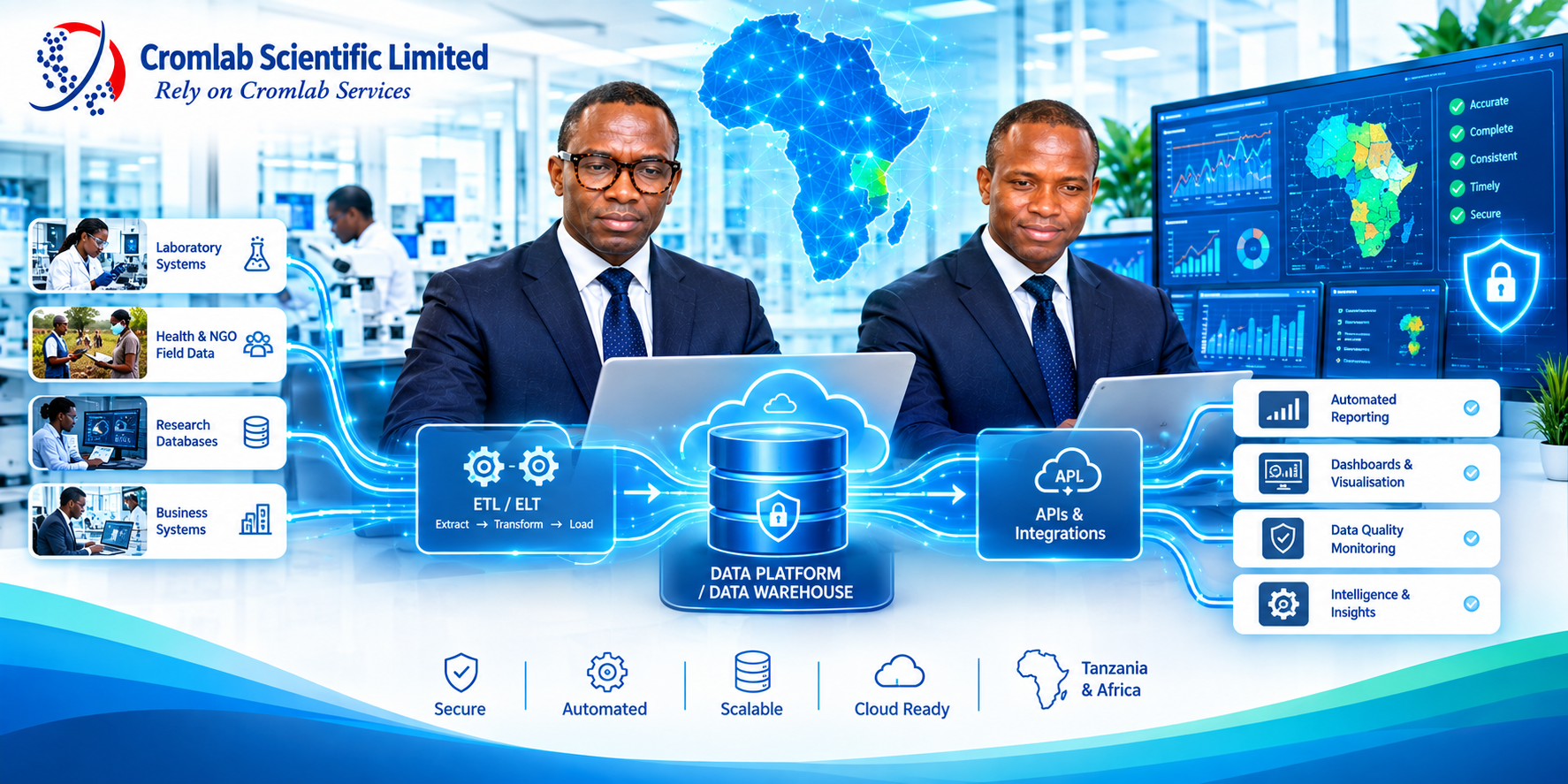
DATA SYSTEMS FOR LABORATORIES, RESEARCH AND ORGANISATIONS
Data Engineering & Intelligencee
CROMLAB designs secure, practical data systems that connect fragmented sources, improve data quality, automate reporting and turn everyday information into timely, trusted decisions.
We support laboratories, health organisations, NGOs, research teams, universities, businesses and public programmes in Tanzania and across Africa. From spreadsheets, field-data platforms and operational registers to dashboards, databases and automated reporting, we build workflows that your team can use, understand and sustain.
Built around your workflow, documented for continuity and designed with responsible data practice in mind.
WHEN DATA WORKS HARDER THAN IT SHOULD
Is your organisation spending too much time managing data manually?
Many organisations collect valuable data but cannot use it quickly or confidently. Information may be scattered across spreadsheets, paper registers, survey platforms, laboratory systems and individual staff files. Reporting becomes slow, data quality is difficult to verify and managers receive answers after the decision window has passed.
Your information sits in separate Excel files, field-data tools, databases, email attachments and paper-based registers.
Missing values, duplicate records, inconsistent codes and unclear indicator definitions reduce trust in the numbers.
Staff spend days reconciling files, checking totals and preparing reports that should be available in hours.
A dashboard cannot create confidence when the underlying process for collecting, cleaning and updating data is weak.
Delayed results, stock-out risks, expiring supplies, equipment downtime and service gaps are not seen early enough.
Teams may lack clear data ownership, access controls, documentation, retention practices and reproducible workflows.
CROMLAB helps you move from fragmented records and repetitive manual work to a trusted data workflow that supports daily operations, reporting, planning and evidence-based action.
From raw data to reliable decisions
01: Connect
Bring together the data sources that matter to your organisation
02: Strengthern
Apply clear structures, quality checks and documented definitions
03: Automate
Reduce repetitive data preparation, reporting and monitoring tasks
04: Act
Give decision-makers timely, understandable and actionable insight
WHAT WE BUILD
Practical data systems, not isolated dashboards
Our work begins with the decisions your organisation needs to make. We then design the data flow, structure, validation, reporting and support required to make those decisions faster and more reliable.
We connect spreadsheets, forms, operational registers, survey platforms, laboratory systems, databases and approved external sources into a structured, maintainable workflow.
We define data structures, validation rules, indicator logic, code lists, exception reports and documentation so that your team can trust what the data mean.
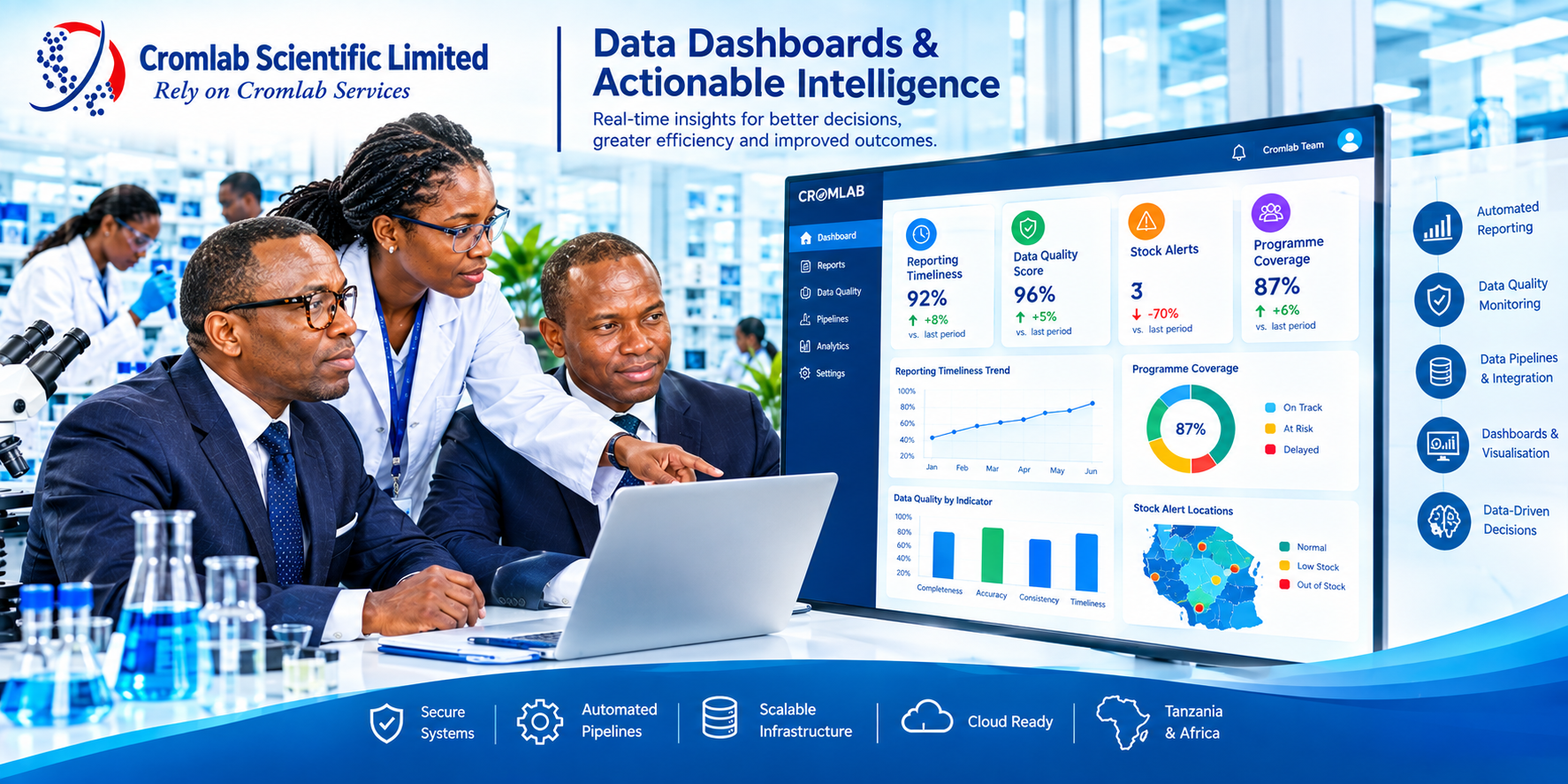
We turn routine updates into decision-ready dashboards, scheduled reports and management summaries without repeated manual consolidation.
We help laboratories monitor samples, turnaround time, inventory, expiry risk, equipment status, quality indicators and reporting performance.
We create integrated systems for indicators, field data, monitoring, research data management, evidence synthesis and donor-ready reporting.
We implement practical access controls, data-flow documentation, retention processes, de-identification workflows and operational safeguards for sensitive information.
Depending on your existing systems and requirements, CROMLAB may work with secure databases, cloud or on-premise environments, APIs, Excel and CSV workflows, KoboToolbox/ODK, DHIS2 exports, R, Python, SQL, Power BI, GIS tools and approved organisational platforms. The goal is not to introduce technology for its own sake; it is to create a maintainable solution that fits your people, processes and budget.
SOLUTIONS BY SECTOR
Build for the environment that matters first
CROMLAB adapts the same disciplined data-engineering principles to the operational reality of each sector.
01: Laboratories and Health Care
Improve operational visibility, quality monitoring and timely reporting
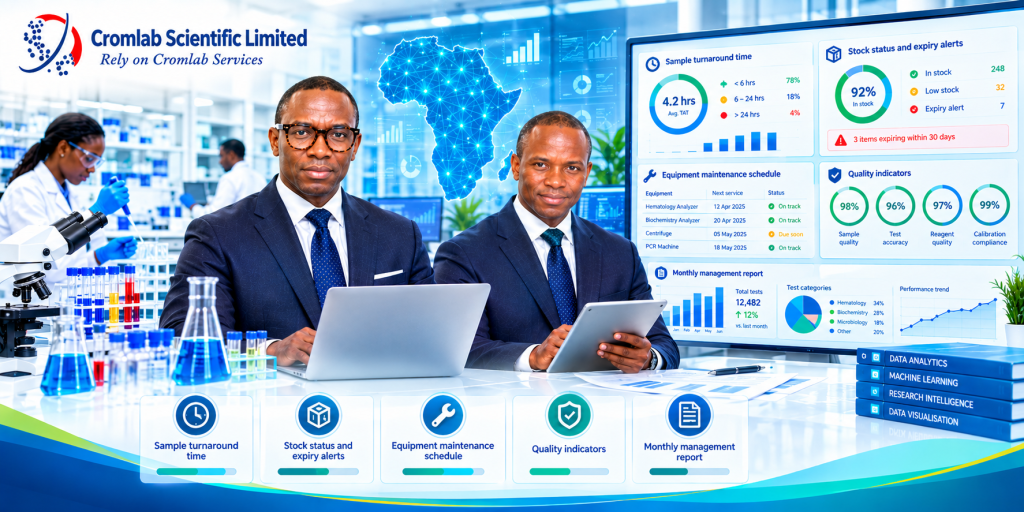
Build a connected view of sample flow, turnaround time, stock levels, expiry risk, equipment maintenance, quality-control indicators and management reporting. We help laboratory and health teams identify bottlenecks early and make operational data more useful.
Turnaround time · Inventory visibility · Quality indicators · Equipment monitoring
02: NGOs & Development Programmes
Turn field and programme data into trusted reporting and learning
Integrate routine monitoring data, surveys, service-delivery records and geographic information into a consistent indicator framework. Reduce reporting delays, improve data-quality checks and create evidence that programme teams, funders and partners can understand.
M&E data hub · Indicator governance · Automated reports · Geographic insight
03: Research & Universities
Create research workflow that are analysis-ready , reproducible and well documented
From study data collection and codebooks to cleaning pipelines, secure data handling, statistical analysis and publication-ready outputs, we help research teams reduce avoidable rework and strengthen reproducibility.
- Data managementReproducible analysis · Research databases · Spatial and statistical workflows
Business & Public Organizations
Make operational data available when Managers need it
Consolidate sales, stock, service, finance, operations and performance data into structured reporting systems. Give decision-makers a clear, timely view of what is happening and where action is required.
- Operations reportingInventory analytics · Performance dashboards · Management insight
FLAGSHIP SOLUTION
Laboratory Operations Intelligence
A laboratory can generate large volumes of operational information every day. CROMLAB helps transform those records into a practical intelligence system for managing workflow, quality, supplies, equipment and reporting.
- Monitor sample volumes, pending work and turnaround time
- Track reagent and consumable use, stock levels and expiry risk
- Review equipment status, service schedules and downtime patterns
- Monitor quality indicators, non-conformances and corrective actions
- Produce management-ready reports without repeated manual consolidation
- Establish data definitions, quality checks and documented procedures
A structured pathweay from data challenges to sustainable systems
We combine technical delivery with practical implementation. Your team remains involved throughout so that the final system reflects real workflows and can be maintained after handover.
- 01 Discover: We clarify the decisions that matter, the users involved, current pain points, data sources, reporting obligations and success measures.
- 02 Assess: We map data flows, review data quality, identify risks and define the current-state and future-state workflow.
- 03 Design: We agree on the architecture, indicator definitions, data model, validation rules, access roles, reporting outputs and implementation plan.
- 04 Build: We develop the pipelines, repositories, automation, dashboards, documentation and supporting tools required for the agreed scope.
- 05 Validate & train: We test results with users, reconcile key outputs, refine the workflow and train designated staff to use and manage the solution.
- 06 Support & Improve: We provide optional ongoing monitoring, maintenance, reporting support, capacity strengthening and continuous improvement.
Start with a focused assessment of your current data workflow and the highest-value opportunities for improvement.
LET’S START WITH YOUR DATA CHALLENGE
Lets start with your data challenge
Request a data system diagnostic
Tell us what is making data difficult in your organisation. A CROMLAB specialist will review your enquiry and contact you to discuss the most suitable next step.
Tell us what is making data difficult in your organisation. A CROMLAB specialist will review your enquiry and contact you to discuss the most suitable next step.
A diagnostic is a focused engagement that helps clarify your data sources, reporting process, risks, priority use cases and practical improvement options. It can be commissioned as a stand-alone assessment or as the first phase of a larger implementation.